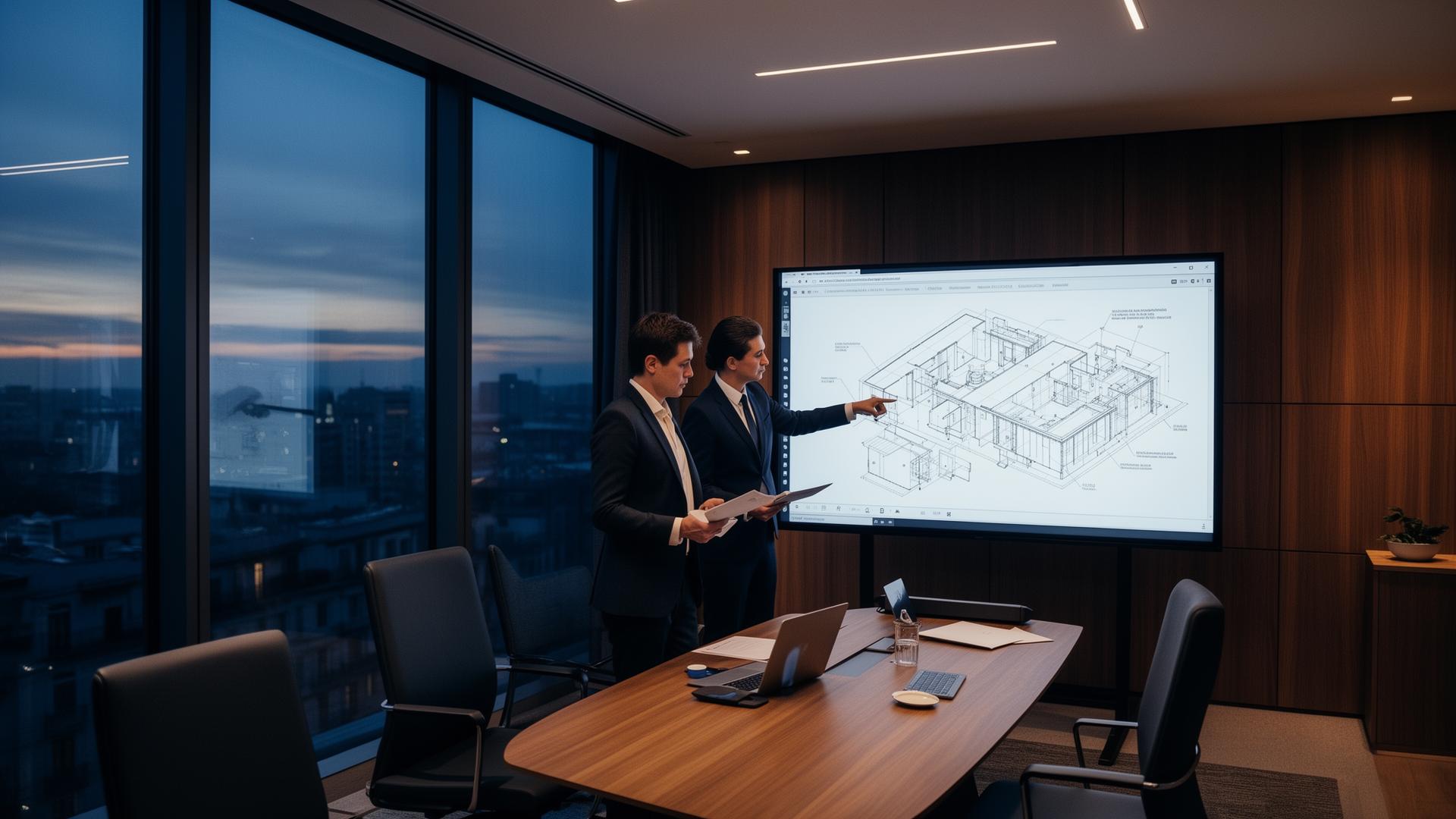
AI is changing how software is written, but its more significant effect is on how software is delivered. The conversation in most boardrooms still focuses on productivity, engineers shipping more code, faster. The harder and more interesting shift is operational. AI is reshaping the structure of delivery itself: how teams are composed, how decisions are made, how quality is governed and where accountability sits.
The productivity story is the smaller story
Code generation, assisted refactoring and inline review have become an ordinary part of an engineer's working day. The gains are real, but uneven. They compound for teams with strong fundamentals and decay for teams without them. AI does not rescue a weak delivery environment; it amplifies whatever discipline already exists.
Where AI changes the picture materially is one layer up. It changes the shape of the operating system around the code: review cycles, knowledge transfer, onboarding, incident response, documentation, test design. The teams that benefit are not the ones with the cleverest prompts. They are the ones whose delivery operations are mature enough to absorb a faster cadence without losing control of it.
AI does not replace engineering governance. It increases the importance of it.
Where AI actually changes engineering operations
1. The cost of context collapses
Onboarding, codebase navigation and historical decision recovery, traditionally the slowest, most person-dependent activities in software delivery, become significantly faster. Teams that operate AI-natively preserve continuity even as people rotate.
2. Review becomes the bottleneck, not authoring
When generation is cheap, the constraint shifts to judgement. Senior engineers spend less time writing and more time reviewing, deciding, refusing and shaping. This is a governance shift, not a tooling shift, and most organizations underestimate it.
3. Quality becomes a design choice, not a downstream filter
Automated tests, static analysis, security scans and policy checks become continuous and inexpensive. The organizations that benefit most are those that decide deliberately what "quality" means for a given system, and let the tooling enforce that definition relentlessly.
4. Delivery becomes legible
AI-assisted observability surfaces what is happening across services, deployments and incidents in a way that used to require a dedicated team of analysts. Leadership gains a clearer operational picture; ambiguity gets harder to hide.
What AI does not change
It does not change ownership. It does not change accountability. It does not produce strategy. It does not decide what the system should be, who it should serve, or what trade-offs are acceptable. These remain organizational questions, and in regulated, European environments, they remain governance questions.
A team that ships twice as much code without a clearer view of what it should be shipping is not a more mature team. It is a more productive team that has compressed its mistakes into a shorter timeframe.
The implication for operating models
In an AI-enabled delivery environment, the operating model matters more, not less. Specifically:
- Decision rights have to be explicit. Faster generation amplifies poorly governed decisions.
- Quality standards have to be codified. Implicit quality cultures do not survive a faster cadence.
- Continuity has to be designed for. AI helps recover context; it does not replace people who hold it.
- Review capacity becomes a first-class concern. Senior judgement is the new constraint.
This is what we mean when we describe our work as AI-enabled operational software delivery , engineering teams that use AI as a serious accelerator inside a mature delivery envelope, not as a substitute for one.
Closing
The organizations that will benefit most from AI in software delivery are not the ones with the most ambitious AI strategies. They are the ones whose delivery operations were already disciplined enough to take advantage of compounding velocity without losing control of it. The work of the next five years is, quietly, less about AI and more about operational maturity.
We explore the team-level implications further in Why AI-Native Engineering Teams Will Outperform Traditional Vendors.